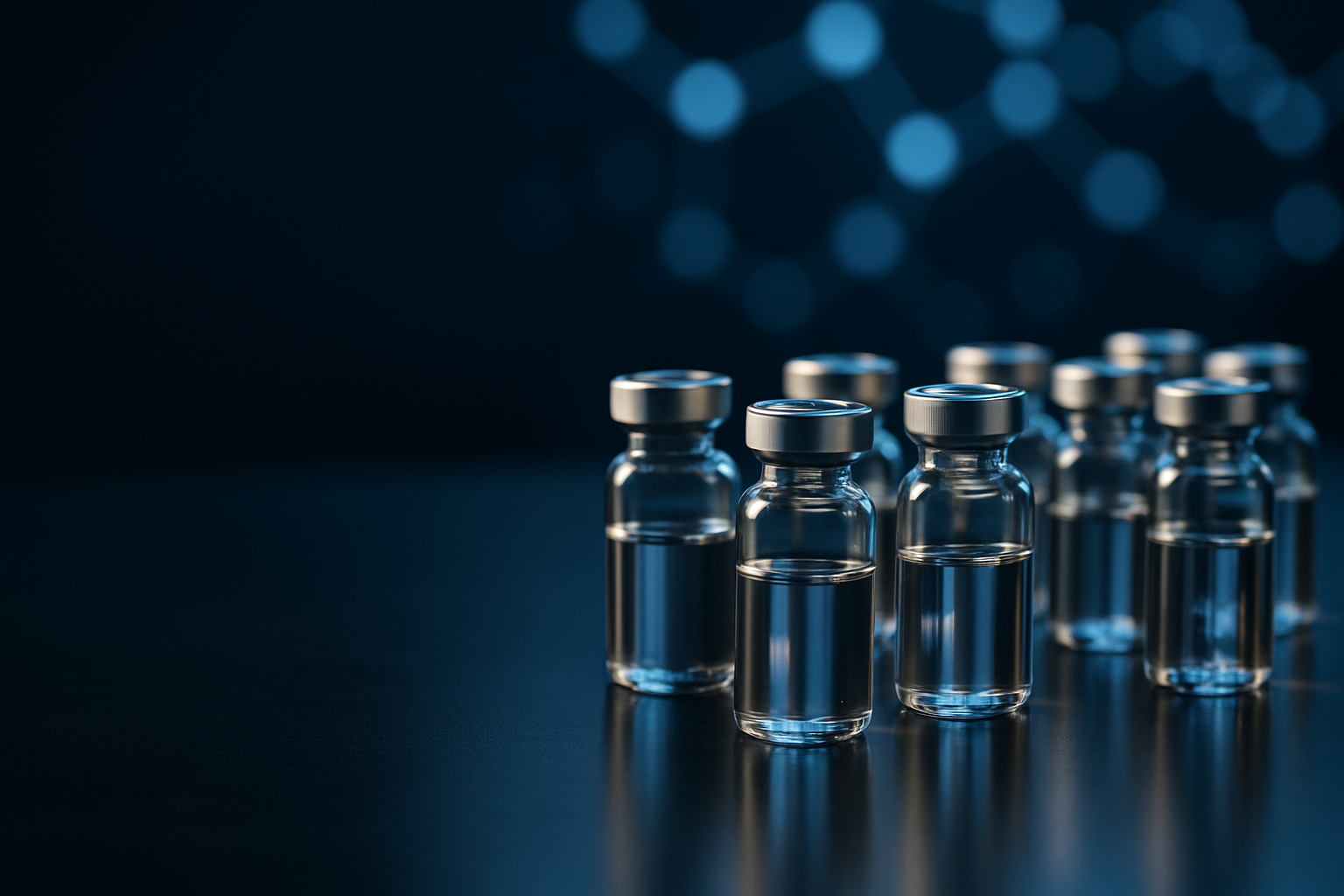
Bacteriostatic Water Canada: Laboratory Handling and Reconstitution Practice
Bacteriostatic water is a standard reconstitution medium in research laboratories across Canada, used to dissolve lyophilised peptides and research compounds for in vitro and animal studies. This guide covers the practical considerations for sourcing, storing, and using bacteriostatic water in a compliant research environment—from bench setup through chain of custody documentation.
Understanding Bacteriostatic Water in Research Settings
Bacteriostatic water is sterile water containing 0.9% benzyl alcohol as a preservative. It is formulated to inhibit microbial growth during storage and use, making it suitable for preparing solutions of research compounds that will be used over multiple sessions or stored between experiments.
In Canadian research facilities, bacteriostatic water serves a distinct role: it is not for human or animal injection, and not for clinical use. It is a reagent for laboratory research applications where sterility and stability over time matter—particularly when reconstituting lyophilised materials that will be aliquoted and stored.
The benzyl alcohol preservative system differs from saline or other diluents; its presence affects both the stability profile of your reconstituted compound and the handling procedures your team must follow. Understanding this distinction is essential before selection.
Sourcing and Supplier Evaluation for Canadian Laboratories
When evaluating a bacteriostatic water supplier, Canadian research teams should assess several practical factors independent of marketing claims.
Request a clear material specification sheet. A legitimate supplier should provide a technical data sheet that describes:
- Origin (reagent-grade vs.
- Preservative concentration and type
- Sterility claim basis (if any)
- Storage conditions recommended
- Shelf life under those conditions
- Any known incompatibilities with common solvents or compounds
Clarify documentation policy upfront. Do not assume third-party testing, HPLC verification, or a certificate of analysis (COA). Many suppliers of research-grade reagents do not routinely perform batch testing or issue analytical documentation. We hold no analytical documentation ourselves, and material should be treated as uncharacterised. If your protocol requires verified purity or microbial testing, confirm in writing that a supplier can meet that need before purchase. Some labs source from vendors who do offer testing; others accept reagent-grade material and perform in-house validation.
Understand order-to-delivery timelines. Canadian laboratories should expect a 10–15 day window from order placement to arrival. Plan reconstitution schedules accordingly and maintain buffer stock if experiments run on tight deadlines.
Confirm labelling and chain of custody. Trace where material originated (the manufacturing partner, not a claimed domestic stock location). Ensure labels carry lot number, receipt date, and your lab's internal tracking codes. This supports regulatory audit trails and traceability if an experiment must be revisited.
Storage, Stability, and Cold-Chain Considerations
Bacteriostatic water's stability depends on storage conditions. Improper handling can compromise the preservative system and introduce contamination.
Temperature control is critical. Most bacteriostatic water formulations are stable at 2–8 °C (refrigerator temperature) for extended periods. Room-temperature storage accelerates degradation of the benzyl alcohol preservative and increases the risk of microbial breakthrough, especially if the bottle is opened repeatedly.
Establish a cold-chain protocol:
- Receive material in insulated packaging with ice packs or dry ice as appropriate for your region's climate.
- Transfer to a dedicated 2–8 °C refrigerator immediately upon receipt.
- Do not expose bottles to freeze–thaw cycles.
- Keep bottles sealed until use; minimise headspace exposure.
- Date all containers upon receipt and track opening date separately.
Handling during reconstitution. Once a bottle is opened, the preservative system begins to be challenged. Best practice:
- Use aseptic technique to withdraw material (sterile syringe, if available; or sterile pour into a graduated cylinder under a biosafety cabinet).
- Minimise air contact; recap immediately.
- Return to 2–8 °C storage within minutes.
- Document each use (date, volume withdrawn, operator).
Shelf life post-opening. Manufacturers' guidelines typically allow 28 days of use after first opening, provided refrigeration is maintained and aseptic technique is followed. If your laboratory uses a bottle sporadically, mark the opening date visibly and discard if the window closes.
Reconstitution Workflow: Lyophilised Peptides and Research Compounds
Bacteriostatic water is often chosen to reconstitute lyophilised peptides because the preservative helps stabilise multi-use stock solutions. This workflow illustrates practical steps.
Preparation phase:
- Gather the lyophilised peptide vial, bacteriostatic water, sterile syringes (if aseptic technique is your standard), graduated cylinders or pipettes, and a weighing boat or sterile container.
- Clean your bench with 70% ethanol; allow to air-dry.
- If working under a biosafety cabinet, perform all steps within the hood.
Calculation and addition:
- Calculate the required volume of bacteriostatic water based on your desired final concentration.
- For example, a 10 mg vial reconstituted in 1 mL yields a 10 mg/mL solution.
- Slowly add the water to the lyophilised cake; do not inject forcefully, as this can create foam or aerosolise the powder.
- Allow 5–10 minutes for the peptide to fully dissolve; gently swirl (do not shake vigorously, which can denature some compounds).
Stability of reconstituted solutions:
- Once reconstituted, the solution contains both the peptide and the preservative. Stability varies by compound; bacteriostatic water does not guarantee indefinite shelf life for your reconstituted material.
- Many peptides remain usable for 7–14 days at 2–8 °C; others degrade faster. Consult your compound's published stability data if available.
- If you plan to store for weeks, consider aliquoting into smaller sterile vials to minimise repeated exposure to air and bacterial ingress.
Documentation.
- Record date of reconstitution, operator, initial peptide mass, volume of bacteriostatic water added, final concentration, and storage location.
- Label the reconstituted vial with the compound name, concentration, reconstitution date, and expiry date (calculated based on your stability assumption).
- Link this record to your chain-of-custody log for traceability.
Assessing Laboratory Readiness Before Ordering
Before sourcing bacteriostatic water, evaluate whether your facility is prepared to use it correctly.
Storage infrastructure. Do you have a dedicated 2–8 °C refrigerator that maintains stable temperature and is not used for food or other incompatible materials? Verify temperature stability with a dedicated thermometer or data logger if precise control is required by your protocol.
Aseptic technique capability. If your SOP calls for sterile technique, are staff trained and equipped? Alternatively, if you accept that a bottle will be used within a short window and kept sealed except during withdrawal, less formal aseptic training may suffice—but document your assumption.
Documentation systems. Can your laboratory reliably track opening dates, use logs, and storage conditions? Spreadsheets, paper logs, or LIMS entries all work, provided they are complete and retrievable.
Waste disposal. Bacteriostatic water, once used, is a chemical waste stream. Confirm that your facility has a protocol and container for safe disposal of unused or expired material.
Evaluating Supplier Claims: A Critical Perspective
As a researcher, you will encounter marketing language around bacteriostatic water. Here are phrases to scrutinise:
- "Pharmaceutical grade" or "high purity": These terms are not standardised. Ask for a specification sheet. If none is offered, treat the material as uncharacterised reagent.
Many do not. Clarify this in writing before purchase.
- "Sterile": Sterility is a claim that should be backed by validation data (e.g., USP <71> sterility testing). If a supplier makes this claim without providing evidence, remain skeptical.
- "Best price" or "lowest cost": Avoid selecting suppliers on price alone. A cheaper product of unknown specification may introduce uncontrolled variables into your research.
Your goal as a buyer is transparency, not promises. A supplier who clearly states what they do and do not provide (e.g., "no analytical documentation") is more trustworthy than one who implies certifications without evidence.
Closing Note: Research Use Only
This article is for educational purposes and applies to laboratory research use of bacteriostatic water. Bacteriostatic water is not intended for human or veterinary use. Always consult your institution's safety protocols, your compound's technical data sheet, and primary literature for reconstitution and storage guidance specific to your research application. This is not medical or clinical advice.